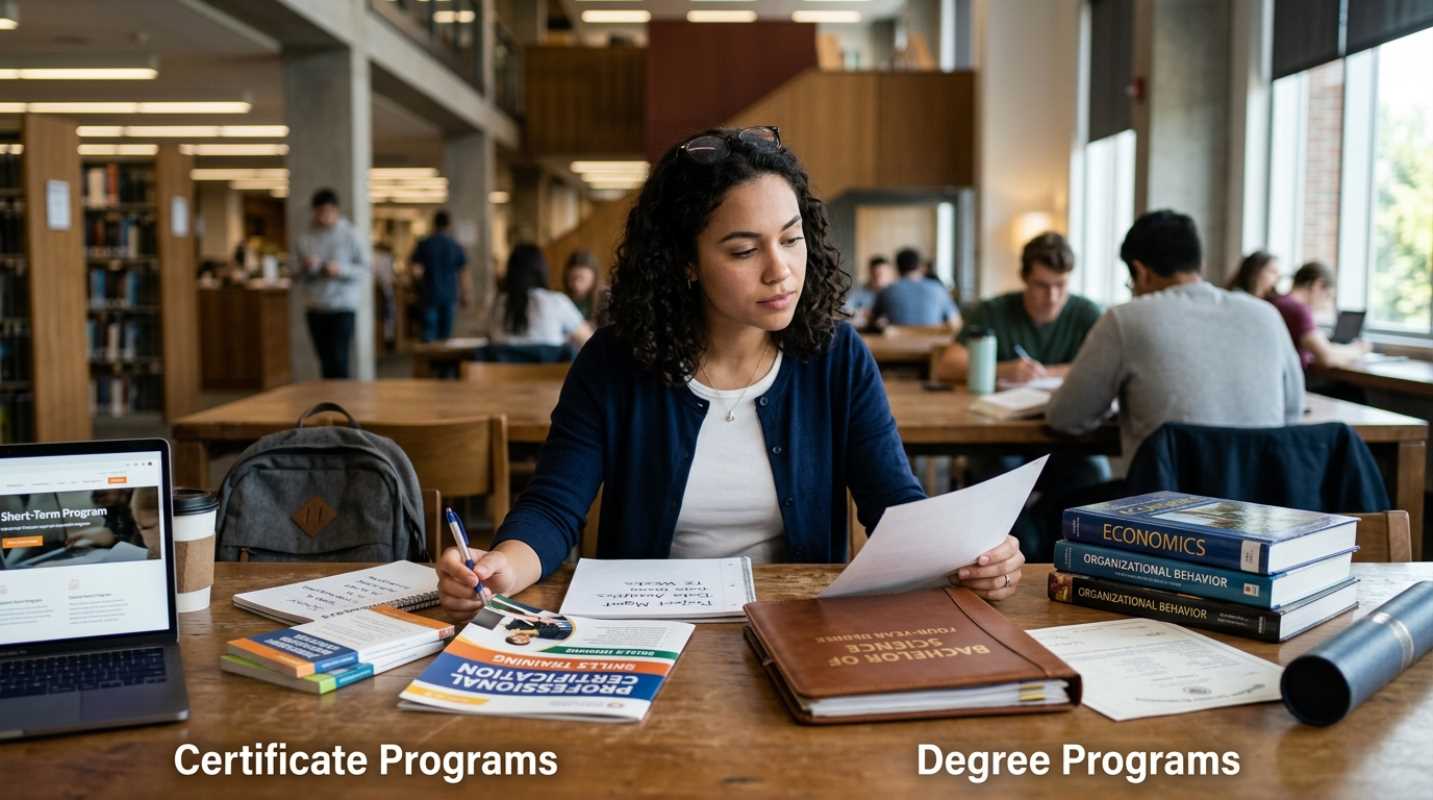
Let's face it. The higher education scene is in the middle of a massive shakeup in 2026. With national student debt piling up and AI changing how we work every single day, the old rulebook has been thrown out the window. You no longer have to default to a four-year university degree to build a successful career.
But how do you choose? The core difference is simple. A degree is a long-term, broad academic commitment that teaches you how to think. A certificate is a fast, hyper-focused training program designed to teach you how to do a specific job.
This article is here to help you cut through the marketing noise. We'll look at the real numbers, the hiring trends, and the return on investment (ROI) so you can make the smartest move for your career.
The Power of Certificates Speed and Specialization
If you want to get into the workforce fast without drowning in debt, certificate programs are incredibly attractive. These programs usually take anywhere from 3 to 12 months. They cost between $200 and $10,000, which is a tiny fraction of a typical university tuition bill.
Instead of spending semesters studying medieval history or theoretical physics, you focus purely on practical skills. Think of it like a laser-focused boot camp. These programs are especially powerful in high-demand fields like technical trades (think HVAC, electrical, and welding), healthcare support, and IT. In fact, undergraduate certificate programs saw a massive enrollment surge, reaching 579,400 completers in the 2024-25 academic year.
Have you noticed how many big companies are dropping their degree requirements lately? It is not just a passing phase. In 2026, skills-based hiring is at an all-time high. A study by TestGorilla found that 85% of employers globally now use skills-based hiring. Tech giants like Google, Apple, and IBM have systematically stripped college degree requirements from their job postings. They do not care where you went to school. They care about what you can actually do on day one.
Even the classic GPA filter is dying. Back in 2019, nearly three-quarters of employers screened candidates by GPA. By 2026, that number plummeted to just 42%. Why? Because companies realized that a high GPA in college does not guarantee you can write clean code or manage a project. ADP reports that 90% of companies hiring based on skills over degrees make fewer hiring mistakes. That is a massive win for anyone holding a targeted certificate.
There is also a huge benefit in how you can build your credentials over time. Many modern professionals use a stackable approach. You earn a quick certificate to get your foot in the door and start earning a paycheck. Later, you can apply those certificate credits toward an associate or bachelor's degree when you have the time and money. It is a highly flexible way to build a career.
The Value of College Degrees Depth and Long-term Versatility
Even with the rise of short-term training, the traditional college degree is far from dead. A bachelor's degree gives you broad foundational knowledge, sharpens your important thinking, and polishes your communication skills. These are the soft skills that do not expire when technology changes.
The long-term financial benefits of a degree remain massive. College graduates still enjoy a major wage premium. Full-time working adults with a bachelor's degree earn a median of $81,800, which is 60% more than those with only a high school diploma.¹ By the time you reach mid-career, between ages 35 and 44, 40% of bachelor's degree holders make over $100,000 a year. For advanced degree holders, that number jumps to 58%.
There is also the safety net factor. The unemployment rate for young adults with a college degree is just 3.1%, compared to 5.8% for those without one. Plus, if you want to climb into upper management, lead a department, or enter specialized fields like law, medicine, or engineering, a degree is still a non-negotiable barrier. You simply cannot get those jobs without one.
Comparing ROI Time, Cost, and Commitment
Let's look at the hard math because this is where things get interesting. When you contrast the two paths, you are weighing a fast sprint against a marathon.
A bachelor's degree takes three to four years of your life and costs anywhere from $20,000 to over $80,000 in tuition alone. That is a massive upfront investment. You also have to consider the opportunity cost of not working full-time for four years.
Because of this, certificates win the short-term ROI battle easily. A report by the Georgetown University Center on Education and the Workforce found that 91% of the top-performing schools for 10-year ROI were institutions that mostly grant certificates or associate degrees.² Like, certificate programs at trade schools show incredible short-term returns, allowing graduates to start earning high wages almost immediately.
But if you look at a 40-year career, the picture flips. The median 40-year ROI for a public bachelor's degree is nearly $1.8 million.² Public certificate programs bring in about $1.37 million.²
You also have to watch out for the credential value gap. Not all certificates are worth the paper they are printed on. A study by the Burning Glass Institute and the American Enterprise Institute analyzed over one million non-degree credentials and found a shocking truth: only 12% of them actually lead to a significant pay bump.³ The other 88% do not help your wallet at all. In fact, 23% of certificate graduates end up earning less than people with no college experience at all. That makes certificates a high-risk, high-reward option.
Making the Right Call Which Path is for You?
So how do you decide? It mostly depends on where you are in your career right now. Here is a quick framework to help you map out your next move.
• Career Switchers: A targeted certificate gets you job-ready in months without tuition debt.
• Technical Specialists: Fields like cybersecurity, HVAC, and welding value hands-on certificates over broad degrees.
• Aspiring Managers: If you want to climb into executive leadership, a traditional bachelor's degree remains the golden standard.
But you do not actually have to choose one or the other. The smartest professionals in 2026 are combining both. You can use a degree to build your foundational knowledge and communication skills, and then use targeted certificates in areas like AI or project management to keep your technical skills sharp. This is especially important because technical skills now have a half-life of under 2.5 years.
No matter which path you choose, continuous learning is the only way to stay ahead.
If you are ready to take the next step in your professional development, here are some curated options to help you get started.
Sources:
1. College Board Education Pays Report
https://newsroom.collegeboard.org/college-degree-still-pays-student-choices-matter
2. Georgetown University Center on Education and the Workforce ROI Study
https://feed.georgetown.edu/access-affordability/ranking-thousands-of-colleges-by-return-on-investment/
3. Hunt Institute College Credentials and Degree ROI Value Report
https://hunt-institute.org/resources/2025/12/college-credentials-degree-roi-value/
*This article on answersgalore.net is for informational and educational purposes only. Readers are encouraged to consult qualified professionals and verify details with official sources before making decisions. This content does not constitute professional advice.*