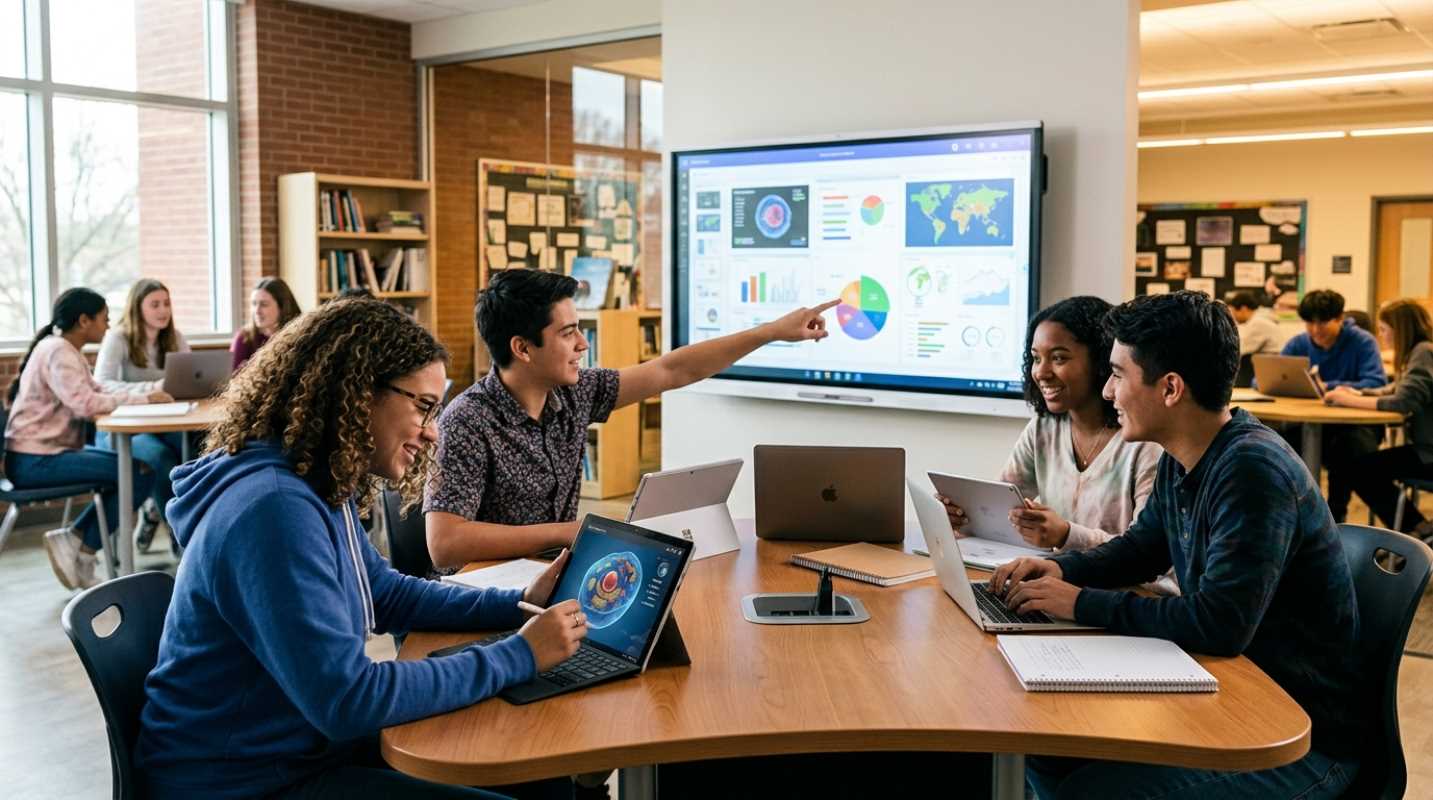
Remember the smell of old, musty school textbooks? The ones with the previous owner's doodles in the margins and facts that were already a decade out of date? Those days are officially over. Today, you walk into a classroom and you're much more likely to see students tapping on tablets, collaborating on shared digital docs, and interacting with smart screens. Moving from physical paper to digital interfaces saves paper, but more importantly, it changes how we interact with information.
This digital shift is breaking down the physical walls of the classroom. A student in a rural town can now join a live lab session with peers across the globe. You don't need to be physically present in a lecture hall to get a world-class education anymore.
By now, in 2026, the hybrid model is the standard. It's no longer an emergency backup plan. It's how we do things. Students expect a mix of in-person collaboration and flexible online resources that they can access on their own terms.
If you look at how classrooms are changing, the shift boils down to three major movements
• Interactive Screens: Static textbooks are being replaced by dynamic, up-to-date digital interfaces.
• Global Classrooms: Geographic limits are gone, letting students collaborate with peers anywhere in the world.
• Hybrid Schedules: A permanent blend of in-person learning and digital flexibility has become the standard.
Personalized Learning Through AI and Data
Let's talk about the old way of learning. For over a century, school was basically an assembly line. Everyone sat in neat rows, listened to the same lecture, and took the same test at the exact same pace. If you struggled, you fell behind. If you already knew the material, you bored yourself to tears.
AI is finally breaking that industrial mold. Today, smart algorithms can track how you learn in real time. If you're sailing through algebra but get stuck on quadratic equations, the system notices instantly. It adjusts your dashboard, serves up extra practice, and slows down the pace just for you.
Recent data shows that these personalized AI learning systems can boost student outcomes by up to 30% compared to the old, one-size-fits-all methods. In fact, a study showed that 81% of students felt digital learning tech improved their grades, and 82% said it gave them more time to study.
But it's not just about the students. Think about the teachers. Instead of grading papers late into the night, teachers get real-time dashboards showing exactly who is struggling and why. This feedback loop is instant. Like, one university used AI analytics to track student behavior in a high-dropout course and used those insights to reduce the dropout rate by 5% in just one year.³
Of course, it's not all perfect. A report released late last year from the Center for Democracy and Technology showed that 70% of teachers worry that relying too much on AI is weakening students' important thinking and research skills.¹ You can't just let an algorithm do all the heavy lifting.
The Accessibility Revolution in Online Education
Have you ever wanted to learn a new skill but realized the nearest class was two hours away or cost a month's rent? That barrier is crumbling. Online platforms are opening up high-quality education to anyone with an internet connection.
Recently, roughly 33% of all undergraduate students were taking at least some distance education courses, with nearly a quarter of them studying completely online. This isn't just a trend for teenagers. It's a lifeline for adult learners. If you're juggling a job and kids, you need speed, flexibility, and affordability. Mobile-first learning architectures let you study during your lunch break or after the kids go to sleep.
The numbers reflect this huge shift. The online university market in the U.S. alone climbed to an estimated $94 billion recently, making it a massive force in modern education.
If you look at what these non-traditional students prioritize, it usually comes down to three things
• Speed: They want direct pathways to completion without unnecessary fluff.
• Flexibility: They need to study around work schedules and family commitments.
• Affordability: They want high-quality education without the massive debt of traditional campus life.
But we have to look at the flip side. Although digital tools can democratize learning, they also highlight a massive gap. In the U.S., about 15% of families with school-age kids still don't have home internet. If you don't have a reliable laptop or a fast connection, you're locked out of this new digital world. We have to bridge this digital divide, or we risk leaving millions of students behind.
Preparing Students for a Tech-Driven Workforce
Let's be honest. Nobody gets hired today for their ability to memorize dates or state capitals. You can look that up in two seconds. What employers actually want are people who can solve complex problems, collaborate across time zones, and adapt to new tech on the fly.
That's why schools are changing what they teach. Digital literacy is no longer an elective class you take once a week. It's baked into every single subject. Students are using collaborative tools that look exactly like the remote work environments they'll enter after graduation. They're using shared workspaces, video platforms, and project management tools before they even get their high school diplomas.
To succeed in this new environment, students need to build a fresh set of skills
• Digital Literacy: Navigating platforms and tools is now a basic requirement, not an extra skill.
• Virtual Collaboration: Working in remote teams across different time zones is the new normal.
• Important Evaluation: Spotting errors and bias in AI-generated content is more important than memorizing facts.
In an AI-assisted world, the value of raw information has plummeted. The value of important thinking, but has skyrocketed. It's about knowing how to ask the right questions, verify sources, and spot bias in an AI-generated answer.
The Future of Balancing Innovation with Human Connection
With all this talk of algorithms, virtual reality, and automated grading, you might wonder if teachers are about to become obsolete. Absolutely not. In fact, their human role is more important than ever.
Think of it this way. AI can teach you the rules of grammar, but it can't inspire you to write a story that moves people. It can grade a math quiz, but it can't notice that you're having a rough day and need a word of encouragement. We need to remember that technology is just a tool, while teachers are the heart of the classroom.
Recent surveys show that teachers who use AI tools at least weekly save about 5.9 hours every week. That's nearly six weeks of administrative time saved per school year. Teachers are using that extra time to do what they do best: mentoring, guiding, and connecting with students on a human level.
We also have to be careful with how we use these tools. Around half of all students surveyed recently admitted that using AI in class made them feel less connected to their teachers. That's a warning sign we can't ignore. Interactive tools like VR and collaborative platforms can boost engagement, as shown in studies of high school STEM classes, but they must support human interaction, not replace it.²
Education is no longer a phase of life that ends when you turn twenty-two. It's a lifelong journey. The tools we're building today are giving everyone the power to keep learning, adapting, and growing for the rest of their lives.
Sources:
1. Center for Democracy and Technology Report
https://www.edweek.org/technology/rising-use-of-ai-in-schools-comes-with-big-downsides-for-students/2025/10
2. Contemporary Educational Technology Study
https://www.cedtech.net/article/students-perceptions-of-the-impact-of-interactive-technology-on-engagement-in-stem-classes-17408
3. Digital Learning Institute Insights
https://www.digitallearninginstitute.com/blog/the-future-of-learning:-what-to-expect-in-digital-learning-in-2025